
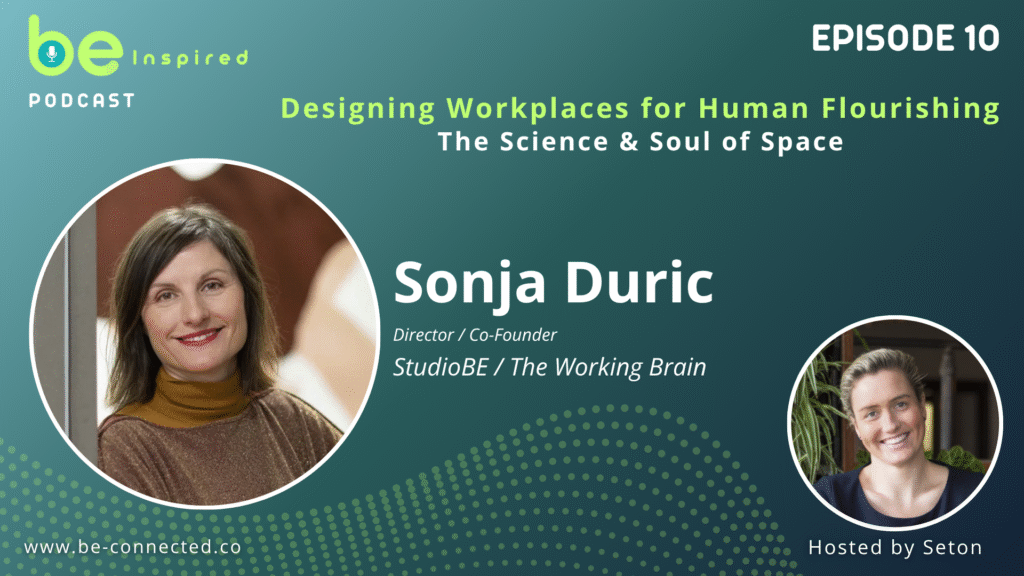

Episode Title: Designing Workplaces for Human Flourishing – The Science & Soul of Space
Guest: Sonja Duric – Director, StudioBE | Co-Founder, The Working Brain
Curious how design can actually help people feel safer, calmer, and more supported? Meet Sonja Duric — the designer, using evidence, empathy, and neuroscience to reshape how we build our world.
In This Episode:
In this episode, Seton sits down with Sonja Duric, Director of StudioBE, to explore how design can deeply influence human wellbeing from workplaces to schools to trauma-informed spaces.
Sonja shares her journey from London’s design scene to leading a research-driven studio in Melbourne, and how her curiosity led to The Working Brain — a groundbreaking study on sensory profiling and workplace design for neurodiverse and neurotypical people alike.
The conversation expands into universal design, sensory comfort, the evolution of schools, unconscious bias in space, and StudioBE’s mission to create environments that truly support the most vulnerable from children giving evidence in court to people recovering from trauma.
This episode is a powerful reminder: Space isn’t just where we work — it shapes how we think, feel, connect, heal, and thrive.
We dive into:
- Sonja’s Story & Creative Foundations
- Cultural Differences in Design
- Building a Practice Based on Creativity & Care
- The Working Brain: Sensory & Neurodiversity Research
- Designing Trauma-Informed Spaces
- Schools, Pedagogy & Future Generations
- The Evolution of Work & Sensory-Based Working
- StudioBE’s Purpose & Social Impact
Connect and Follow Sonja Duric:
LinkedIn: linkedin.com/in/sonja-duric-3a14a238
Website: https://studiobe.com.au
Takeaways:
- Design is not cosmetic — it’s behavioural.
Space shapes how people feel, think, focus, and interact. - Universal design isn’t for the minority — it benefits everyone.
- 60% of people have heightened sensory needs.
Designing for neurodiversity automatically improves environments for the majority. - Sensory choice = psychological safety.
People thrive when they can choose quiet, active, or recalibration zones. - Trauma-informed design saves lives.
Sonja’s work in court and justice settings demonstrates how design can protect and empower people experiencing violence. - Kids and future generations need sensory-aware spaces in schools, not just architectural templates.
- Designers have the power to create healthier futures, not just beautiful spaces.
Chapters:
00:00 – Welcome & introduction
00:34 – Sonja’s story & early design career
03:00 – London vs Australia: cultural differences in design
06:00 – Building teams, culture & moving between practices
09:50 – StudioBE’s values and evolution
16:20 – Why sensory design matters
18:00 – The Working Brain research
21:00 – Neurodiversity, sensory profiles & universal design
24:00 – Sensory-based working: quiet, active & transition zones
28:00 – Why workspace design impacts wellbeing
32:00 – Schools, children, pedagogy & future spaces
37:00 – Trauma-informed design & court projects
42:00 – StudioBE’s social impact focus
44:00 – Recommended books & resources
48:00 – Closing reflections
Sound Bites / Quotes:
“Universal design is good for us all.”
“60% of us have a sensory profile outside the standard range and most workplaces aren’t designed for us.”
“We want spaces where people can choose the environment they need to thrive.”
“Design can support healing especially for people experiencing stress, trauma, or vulnerability.”
“Creativity and care should sit at the centre of every design practice.”
“The environment around us affects our senses more than we realise.”
“Designing for the most vulnerable creates better outcomes for everyone.”
Referenced in This Episode:
- Living Sensationally: Understanding Your Senses — Dr Winnie Dunn
https://www.amazon.com/Living-Sensationally-Understanding-Your-Senses/dp/184310915X - The Working Brain – StudioBE Research Initiative
https://www.studiobe.com.au/the-working-brain - Neurodiversity Hub (Enabling Spaces Section)
https://www.neurodiversityhub.org - Dr Winnie Dunn
- Andrew Eddy (Neurodiversity Hub founder)
- Carl Taylor
- Mark Sheldon
LET’S BE CONNECTED